
GLP-1: The Silent Consumer Recession Already Underway in Your Market
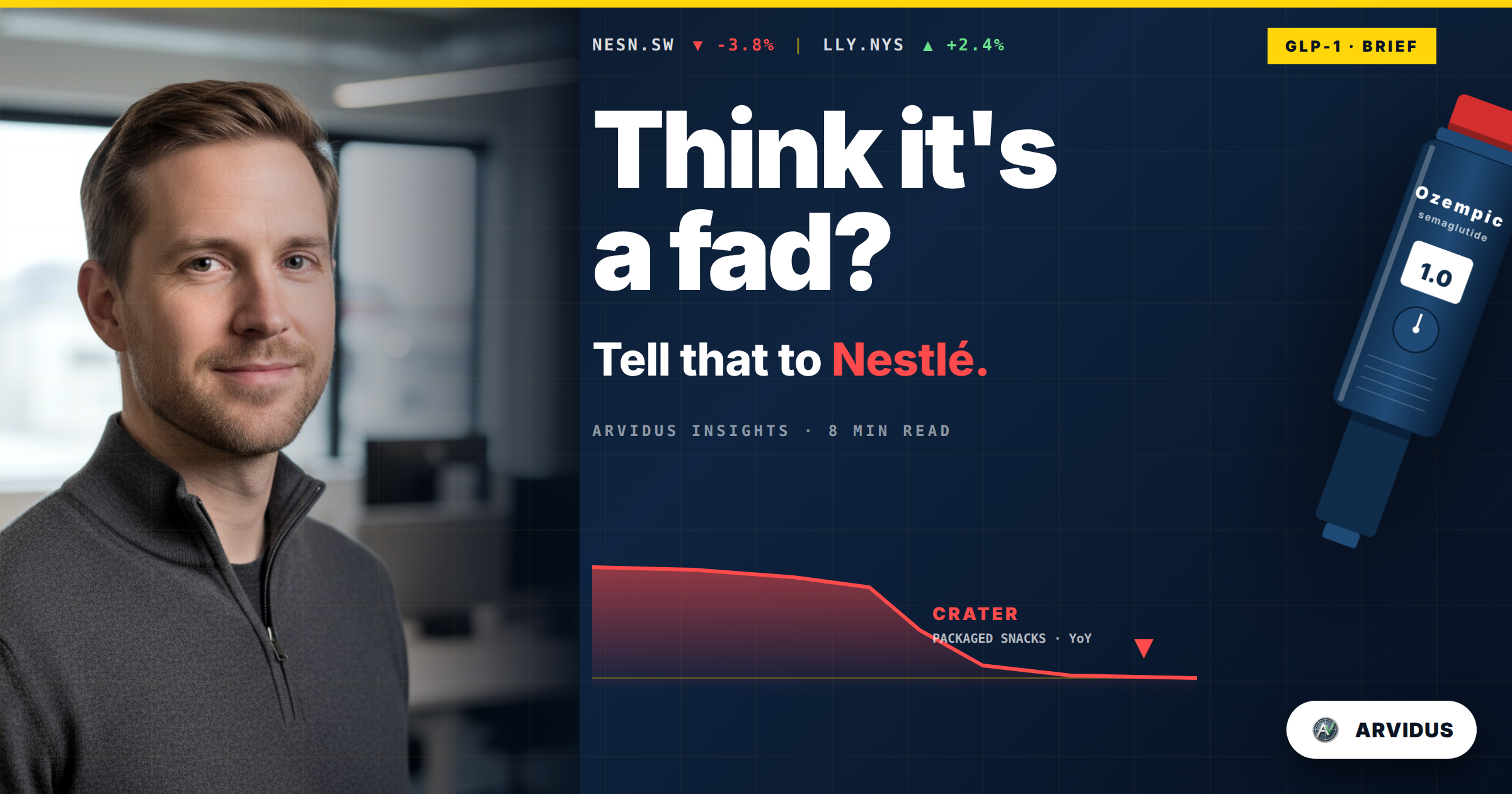
Forty billion dollars in GLP-1 sales in 2024 alone. Cornell tracked a 5.3% drop in grocery spend per user household. Nestlé built a brand from scratch. Fads don't move 150-year-old multinationals.
Forty billion dollars. That was the combined GLP-1 revenue of Eli Lilly and Novo Nordisk in 2024. In a single quarter of 2025, Mounjaro and Zepbound alone hit $10.1 billion. Up 131% year over year.
One in four American households now has someone on a weight-loss pen. Cornell tracked 150,000 households and surfaced the number that should be on every board agenda: people who start using GLP-1 cut grocery spending by 5.3% within six months. In high-income families, the cut goes past 8%.
Still think it's a fad? Then why did Nestlé build an entirely new brand from scratch for this consumer? Fads don't move 150-year-old multinationals. Structural reconfigurations do.
The Size of the Tsunami
Ten million Americans are on GLP-1 today. One in eight adults. Morgan Stanley projects 31.5 million by 2035, almost 9% of the population. Goldman Sachs sees a $130 billion market by 2030. Morgan Stanley goes further, $190 billion by 2035.
The disagreement among the banks isn't whether it will happen. It's about how big.
GLP-1 households are projected to account for 35% of all units sold in food and beverage by 2030. If your five-year plan doesn't carry this variable, it's not a plan. It's a wish.
The Cascade Has Already Started
First came snacks. Mondelez, owner of Oreo and Cadbury, lost 4.1% in net North American revenue in Q3 2025. The CEO said it openly, consumers migrated to eggs and lean protein. Hershey is guiding for a 36 to 38% drop in adjusted EPS in 2025. Unprecedented in the company's history.
Then fast food. Dinner traffic fell 6% among GLP-1 users. In the first twelve months of treatment, fast food spend collapses 8%. McDonald's is estimated to be losing 28 million visits per year, equivalent to $481 million. Domino's has $130 million at risk. The Domino's CEO says he "doesn't see impact yet". The market disagrees.
Then alcohol. EY-Parthenon survey of GLP-1 users: 44% drink less. And the number that should keep every brewery up at night, 82% keep the reduced habit even after stopping the medication. This isn't a temporary effect. It's neurological rewiring. Morgan Stanley estimates a drop of up to 75% in individual consumption. Global beer volume fell 2.9% and wine 4.4% in the past year, according to Nielsen.
Then fashion. Torrid, the plus-size specialist, saw sales drop 14.3% in Q4 2025 and doubled its losses. Target cut 37% of extended-size options on its website. DXL estimates that up to 25% of its customers are on GLP-1. On the other side, the estimate is $13 billion in additional annual apparel spend from people rebuilding their entire wardrobe.
Then bariatric surgery. Down 46.4% in three years among eligible patients, per a Mass General Brigham study. From gold standard to second option at record speed.
And now even aviation. Jefferies ran the math, if society gets 10% slimmer, weight on flights drops 2%, generating $580 million per year in fuel savings for the four largest US airlines alone. Without doing anything.
The Walmart CEO summed it up, GLP-1 customers buy "fewer units, slightly fewer calories". Smaller baskets. Different mix. Worse margin on ultra-processed.
This list isn't a hypothesis. It's what already happened. Every quarter, more sectors join it.
If It's a Fad, Why Are the Smart Ones Doing This?
Let's look at what the companies that understand money are doing. None of them are waiting to see.
Nestlé Vital Pursuit. Not a reformulation of an existing product. A new brand, built from scratch, for the GLP-1 consumer. Bowls, egg bites, high-protein pizzas. In 2025, the company launched the Max Pro extension with an explicit "GLP-1 friendly" claim. A 150-year-old company doesn't build a new brand for a fad. It does so because it modeled the scenario and saw the market would be there.
Conagra. Picked the fastest path. In January 2025, the company took the Healthy Choice line, which already had the right nutritional profile, and added the "GLP-1 friendly" badge. No reformulation. Just aligned the messaging to a reality already inside the product. In 90 days, it was on shelves. Minimal cost, immediate result.
Coca-Cola. Accelerated what it already had: Coke Zero, Powerade, Fairlife (protein), Topo Chico. The internal read was explicit, GLP-1 users drink more diet sodas, more hydration, more coffee, more protein drinks. Instead of defending the old product, the company surfed the wave with the portfolio it already had ready.
McDonald's. Started testing higher-protein menus and smaller portions. CNBC reports that "smaller portions and protein" are the levers the chain is testing. Quiet adaptation, but real.
Planet Fitness. Launched educational content about muscle mass maintenance for GLP-1 users. Equinox and Life Time rolled out premium "muscle-sparing" programs. It tracks, 42% of GLP-1 users increase physical activity after starting treatment. BMO Capital Markets sees low-cost gyms as direct beneficiaries.
Three response patterns. New brand from scratch (Nestlé). Repositioning existing in 90 days (Conagra). Acceleration of an aligned portfolio (Coca-Cola). None of these companies asked the market for permission. And the "GLP-1 drinks" functional beverage market is already on track for $3.5 billion.
Now ask yourself, if all this were temporary, why are so many smart people betting so much money?
The Bomb That's Coming
Everything you've read so far happened with Ozempic costing more than $1,000 per month in the US and Wegovy at 244 euros in Portugal.
That price is the biggest brake on adoption. And it has already dropped.
In March 2026, the semaglutide patent expired simultaneously in Brazil, India, and China. ANVISA denied the extension Novo Nordisk requested. In India, more than 50 brands are preparing to launch. Natco Pharma announced a price of $14 per month. Fourteen dollars. In China, more than 17 generic candidates advanced to Phase 3.
The second bomb, the oral pill. The FDA approved orforglipron (Foundayo, from Eli Lilly) on April 1, 2026. It can be taken at any time, with no food or water restriction. No injection. Price with savings card: $25 per month.
When it cost a thousand, it was elite. When it costs 25, it's structural change. IQVIA estimates that at least one in three people with obesity worldwide lives in a country where semaglutide is already off-patent.
And public coverage is expanding. Medicare in the US will cover Wegovy and Zepbound starting July 2026, with a $50 copay. In Brazil, Wegovy is under evaluation for inclusion in the SUS public health system.
Whoever didn't move in 2024-2025 is already 18 months behind. Whoever waits until 2027 is entering a race they've already lost.
And Closer to Home?
Brazil is already the world's largest emerging market in GLP-1 for obesity, according to IQVIA. Addressable market of $580 million. With the patent expired and Brazil's strong pharmacy and compounding culture, the adoption curve could be steeper than the American one. The Brazilian founder treating this as an "American problem" will get the same shock Mondelez got.
Portugal received Wegovy in April 2025 at 244 euros, with no public reimbursement. It sold 6,800 units in the first month. In Spain, the price sits between 240 and 280 euros, with no SNS coverage. For now it's an upper-middle-class market, but when the generics reach the Iberian peninsula, the game changes. The Mediterranean diet has more protein and fiber at its base, so the total impact may be smaller. But in ultra-processed foods, sugary sodas, and casual beer, the concentration is likely to be just as sharp as in the US.
5 Questions Every Founder Should Be Answering Right Now
If you can't answer them, you're flying blind.
1. How much of your revenue comes from categories where GLP-1 reduces consumption? Snacks, sweet bakery, sugary sodas, beer, high-carb fast food. If it's over 30%, your sensitivity is high and the clock is running.
2. What's the income profile of your customer? The Cornell study of 150,000 households showed the effect on high-income segments exceeds 8%. If you serve the top, it's already happening in your register.
3. Do you have a "GLP-1 friendly" line ready, or would you need to build one? Communicating what already exists takes 90 days (Conagra model). Reformulating, 12 to 24 months. Building a new brand, 18 to 36 months (Nestlé model). How much time do you have?
4. If 30% of the relevant population is on GLP-1 in 2030, what happens to your financial model? Morgan Stanley already has that line in its model. Do you?
5. Is your bet on volume or value per unit? Whoever bets on volume feels the impact first. Whoever bets on value can even gain ground, if they move in time.
3 Scenarios, and Inaction Loses in All Three
Base. The US reaches 9% total penetration by 2035. Brazil and Iberia follow with a 3-to-5-year lag. Generics drop prices only where the patent expired. You need to cut ultra-processed SKUs by 15 to 25% by 2028 and expand protein and fiber. Whoever doesn't, loses margin slowly.
Accelerated. Cheap generics explode. Price falls below $50 per month globally between 2027 and 2028. Oral pills widen access. Penetration in 2030 passes 20% in the US and 8% in Brazil. In this scenario, full portfolio reformulation in 24 months, closing of plants dedicated to declining SKUs, acquisitions in protein and fiber.
Restricted. Side effects show up in population studies. Regulators tighten prescriptions. Public coverage stalls. Penetration stays at 5 to 7% in the US in 2030. Even in this most conservative scenario, you still need a defensive line.
In all three scenarios, inaction is the worst choice. Picking a single scenario, betting everything on it, is the second worst.
The Question Isn't Whether It Will Affect You
It already is. Cornell, Mass General, Target, Mondelez, Jefferies, and Morgan Stanley have already answered. Nestlé already built. Conagra already repositioned. Coca-Cola already accelerated. McDonald's already tested.
The question is different, in how many of the next five years does your business model survive? And in how many does it thrive?
If you haven't stress-tested this in your financial model, you're betting on a single future and hoping the market agrees. In an environment where $40 billion turns into $190 billion in a decade, hope isn't a strategy.
The good news, whoever starts moving now still has a window. The timing isn't perfect, but it's enough. The data is there. The tools exist. What's missing, in most cases, is the decision to look at the numbers head-on.
Sources: Cornell University/Numerator (Journal of Marketing Research, 2025), Morgan Stanley (2026), Goldman Sachs (2024-2025), Eli Lilly investor release (2026), IQVIA (2025-2026), Jefferies (2026), EY-Parthenon (2025), Mass General Brigham (2026), Food Dive (2025), FoodNavigator-USA (2025), Bloomberg (2026), CNN Business (2026), BeverageDaily (2026), BioPharma Dive (2025), CNBC (2026), Nation's Restaurant News (2026), IWSR/Nielsen (2024), Conagra Brands (2025), FoodBev Media (2025), Renascença/Observador (2025), INFARMED (2025), JP Morgan (2026), BMO Capital Markets (2025).