
Franchising Is Not a Safety Net: What the Global Numbers Reveal About Real Risk (and How to Validate Before You Sign)
The myth that 85% of franchises survive five years was disavowed by the SBA itself. Here is what 2024-2025 global data shows about real risk, encroachment, royalties, and how to run due diligence before you sign.
Start With the Discomfort: the Number Everyone Quotes Is Wrong
You have heard the line: "85% of franchises survive five years, versus only 50% of independent businesses." That figure became the industry's master argument and has been repeatedly disavowed by the U.S. Small Business Administration itself. The most rigorous academic study, conducted by Timothy Bates in 1994 with a base of more than 20,500 firms, reached a different conclusion: 65.3% of franchises survived four years, versus 72% of independent businesses (Entrepreneur, 1994). After controlling for entrepreneur profile, the real difference disappears beyond year two.
The inflated statistic survives because franchising-association surveys poll only active franchisees, ignoring those who went bankrupt, sold, or were terminated. It is survivorship bias sold as institutional advertising (Moyak, 1994). Franchising is one of the most efficient mechanisms ever invented for scaling brands and distributing capital, but buying one, in practice, is a problem of probability, not faith.
From the Sewing Machine to the Big Mac: the Real History of Franchising
Franchising was not born in 1950s Chicago. Its roots are medieval: between the 5th and 15th centuries, governments, the Crown, and the Church granted letters patent to feudal lords to tax markets, operate ferries, and collect tolls, with part of the proceeds returning to the Crown as a primitive royalty (IFA, 2019). From the 12th century onward, English breweries began financing taverns in exchange for purchase exclusivity, the tied-house model.
Modern commercial franchising was born in 1851, when Isaac Singer patented the first practical sewing machine. The innovation was not the machine itself, but the structure created by attorney Edward Cabot Clark: a national network of exclusive franchised agencies, each with a sales agent, a demonstrator, and an after-sales mechanic. By 1860, Singer was already the world's largest manufacturer (Wikipedia).
In 1935, lacking capital to open a second restaurant in Cape Cod, Howard Johnson sold a local family the right to use his recipes and brand. By 1940 there were already 132 units following a strict manual (American Business History Center). Business format franchising was born. In April 1955, Ray Kroc opened the first McDonald's franchise in Des Plaines, Illinois, selling unit franchises rather than territorial ones to maintain control over standardization. By 2024 the network had 43,477 restaurants across more than 100 countries, with 95% operated by independent franchisees (McDonald's Corporate, 2024).
This timeline reveals the model's DNA: franchising scales using third-party capital, strict standardization, and recurring royalties. The franchisee is, above all, a motivated financier.
How the Model Works Today, Around the World
There are five main types (MSA Worldwide): product distribution (Coca-Cola, Goodyear), business format (McDonald's, Subway, KFC), manufacturing, master franchise (regional or national subfranchising), and multi-unit or area developer (commitment to open N units in an exclusive territory).
Taking the U.S. as a reference, the typical structure involves an initial fee between USD 20,000 and USD 50,000 (above USD 100,000 for premium brands), monthly royalties of 4% to 12% on gross revenue (up to 20% in some sectors), and a marketing fund of 1% to 4% (SBA, 2023). The critical insight is that the franchisor's real profit comes from recurring royalties, not the initial fee, which misaligns incentives: the franchisor earns on the franchisee's gross revenue, not on net profit. Contracts typically run 5 to 20 years, with optional renewal and arbitration as the dispute forum.
The Numbers Nobody Shows You (and the Ones That Do, Lie)
The sector's absolute numbers are impressive:
- United States: 851,000 franchised establishments, more than 9 million jobs, and projected output of USD 936.4 billion in 2025, up 4.4% year over year (IFA Economic Outlook, 2025).
- United Kingdom: 1,009 active networks, 50,421 units, and sector turnover of GBP 19.1 billion, with an average of GBP 400,000 per unit (BFA / NIC Services Group, 2024).
- Brazil: BRL 273 billion in revenue in 2024, nominal growth of 13.5%, with 3,300 brands and 197,709 units (ABF, 2024).
- Continental Europe: more than 14,900 active systems, with France the most mature at 2,035 networks (EFF, 2024).
- Asia-Pacific: 22% of the global market, with KFC operating more than 10,000 units in China and Japan concentrating more than 21,000 7-Eleven stores (Research and Markets, 2025).
There is, however, an explosive methodological detail. The ABF survey, for instance, has a sample base corresponding to only about 29% of sector revenue. Association surveys tend to be answered by the best-managed networks, generating systematic bias. The aggregate numbers are useful for understanding scale, but they say nothing about your individual probability of success. Compared side by side with the Bates study, the result is uncomfortable: after the second year, the survival rate of a franchise is statistically equivalent to that of a well-planned independent business (Michigan Ross). The brand's flag is not an insurance policy.
Inconvenient Truths the Franchise Salesperson Will Not Tell You
Royalties Kill Margins
A 6% royalty on gross revenue, plus a 2% marketing fund, equals 8% of revenue before any operating costs. In food service, with typical margins of 10% to 15%, that consumes more than half of potential net profit (Goldstein Law Firm).
Encroachment and Mandatory Upgrades
Most contracts do not guarantee an exclusive territory. Subway's FDD (Franchise Disclosure Document) openly states that the brand and its affiliates have unlimited rights to compete with the franchisee itself. Encroachment, the opening of a competing unit by the franchisor, is one of the leading sources of litigation in the U.S. (MSA Worldwide). Vague clauses on system modifications also allow them to demand heavy renovations: McDonald's "Experience of the Future" program cost between USD 160,000 and USD 750,000 per store (Zarco Einhorn Salkowski).
Forced Supply: the Quiznos Case
Exclusivity clauses turn the franchisor into a mandatory distributor. In the Quiznos case, American Food Distributors, a franchisor subsidiary, generated USD 500 million in 2006 selling supplies to franchisees at allegedly inflated prices. The chain reached 5,000 global stores in 2007, filed for bankruptcy in 2014, and by 2017 fewer than 400 units remained in the U.S. It faced a USD 206 million class action for racketeering and fraud, and another USD 95 million suit brought by franchisees who paid the fee but were never able to open (Restaurant Business Online).
Systemic Litigation: the Subway Case
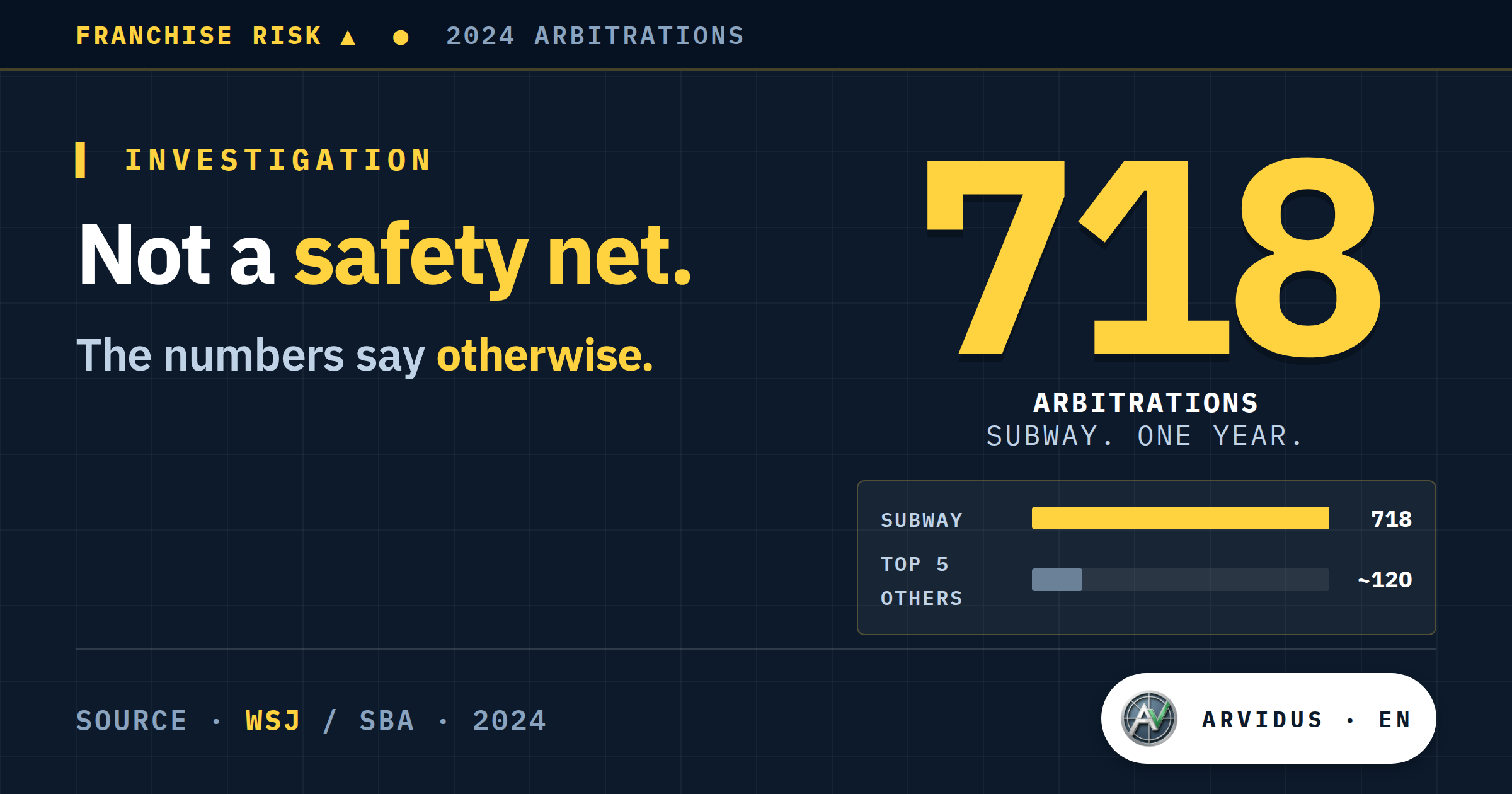
In 2024, the North American Association of Subway Franchisees retained the firm Zarco Einhorn Salkowski to confront systemic issues: approval of stores located too close to one another, inspections allegedly manipulated to force operators out, and 718 arbitration actions against franchisees in a single year, more than all major competitors combined. The chain lost 4,222 stores in recent years (Law.com, 2024). The average franchisee turnover rate in the U.S. is 10.23% over five years, reaching 12.61% in fast food (FranchiseGrade).
Types of Franchise to Keep Off Your List
Based on criteria consolidated by the industry (Garner Legal; FranNet), avoid:
- Brands with fewer than three years of operation, or without a company-owned unit operating for at least three years. The system has not yet ironed out its kinks.
- Models in which the franchisor's cash flow depends mainly on new franchise sales rather than recurring royalties. Pyramid signal.
- Networks with unit churn above 20% over three years (Item 20 of the FDD).
- Franchisors who refuse to provide Item 19, or who show only top performers.
- Litigation history above one to two cases per 100 franchisees (Item 3 of the FDD).
- Sectors in structural decline, such as DVD rental stores or internet cafes.
- High entry tickets without validated unit economics (ROI below 15% after 24 months).
- Franchisors without healthy audited financial statements (Item 21 of the FDD).
Those With a Real Chance of Working
- A brand established for ten years or more, with a track record of at least one recession.
- Annual churn below 10%, sustained for three consecutive years.
- Documented support: initial training of two weeks or more and quarterly visits from field consultants.
- Meaningful geographic diversification, showing that the model does not depend on a single market.
- Validated unit economics, with average payback between three and five years (above seven is a red flag).
- An active franchisee council with real power to influence decisions.
- Multi-unit owners growing inside the system, a sign that existing franchisees reinvest.
Why Validating Data Before You Sign Is Non-Negotiable
The difference between a franchise that works and a five-year nightmare almost always comes down to serious due diligence. Legal frameworks help, but they vary widely by country.
United States: the FDD and the Item 19 Trap
The Franchise Disclosure Document is a federally mandated document with 23 items standardized by the FTC, delivered to candidates at least 14 days before any payment. The most important and most overlooked point is that Item 19, which covers Financial Performance Representations, is OPTIONAL. If the franchisor decides not to include it, a boilerplate sentence stating they make no financial representations is enough (FDD Exchange). In practice, many omit Item 19 precisely because the real numbers are unfavorable. Refusing to provide it is the maximum red flag.
Brazil: Law 13.966/2019 and the COF
Law 13.966/2019 (analogous to the U.S. FDD requirement), in force since March 26, 2020, requires delivery of the COF (Brazilian Disclosure Document, "Circular de Oferta de Franquia") at least ten days before signing or any payment. A little-known detail: missing this deadline triggers contract voidability and the right to recover all fees and royalties paid (Planalto, 2019; SEBRAE), a right rarely exercised due to lack of awareness. The COF must include franchisor history, the last two years of financial statements, a list of units, royalties, INPI (trademark) status, and territorial rules.
United Kingdom and Continental Europe
The U.K. has no federal mandatory disclosure law. The BFA maintains a voluntary Code of Ethical Conduct, and non-member franchisors have no legal obligation to provide a pre-contractual document. France has the 1989 Loi Doubin, with a Document d'Information Précontractuelle delivered 20 days in advance, and Spain enforces Real Decreto 201/2010, with disclosure 20 working days in advance and fines up to EUR 900,000 for repeat offenses (Lexology; ICLG).
The Critical Point: Franchisor Data Reflects Best Performers
Even when formal disclosure is properly delivered, there is a statistical trap. Franchisor data tends to show averages from the top 25% to 50% of units (cherry picking), exclude closed units (survivorship bias), ignore hidden costs such as renovations and fines, and present payback under ideal conditions with no stress scenario. The only real validation requires speaking directly with at least five active franchisees in markets similar to yours, and three former franchisees. In the FDD, Item 20 lists the contacts. In Brazil, the COF provides the full list. Use it.
Eight Anti-Sales-Pitch Tips for Franchise Buyers
- Validate with five active franchisees and three former franchisees in similar markets. The golden question: "Knowing what you know today, would you invest again?" Hesitation is worth more than any brochure.
- Demand Item 19 or its local equivalent with FPRs. Refusal to share financial data is the maximum red flag. Absence usually means the numbers do not sell.
- Calculate break-even including royalties and the marketing fund, in a pessimistic scenario where revenue lands 30% below promises. If it pushes past 24 months, rethink.
- Check the litigation history (Item 3 of the FDD or local case law). More than one to two cases per 100 franchisees indicates a systemic problem. Search the brand on Google together with "lawsuit", "class action", or local equivalents.
- Hire a lawyer specialized in franchising. Critical clauses: territory, renewal, termination, non-compete, arbitration forum, system modifications. A generalist will not see the specific traps.
- Research churn over the last three years (Item 20 of the FDD or COF). Above 15% is an alarm; above 20% is a mass exodus.
- Visit three units during peak hours, unannounced. Talk to customers in line, observe traffic, count tickets, compare real quality with the brand's marketing material.
- Do not let the salesperson's enthusiasm bypass your due diligence. Pressure to decide within the week or lines like "this is the last unit available" are well-known tactics. A legitimate franchisor knows that a good candidate decides slowly.
Conclusion: It Is a Decision of Probability, Not Faith
Buying a franchise means taking on dense contractual obligations in exchange for a supposedly validated model. The global data shows the model is powerful for scaling brands, but it is no insurance policy against bankruptcy. The real survival gap between a well-chosen franchise and a well-planned independent business is smaller than the industry would like you to believe.
The right question is not "does this franchise have a good brand?", but rather "what is the probability that this unit, at this location, with my capital and my profile, will survive five years?". Marketing material does not answer that. Answering it requires stress-testing the model: simulating below-average revenue, full royalties, a mandatory upgrade in year three, a new unit from the same franchisor opening three kilometers away. How many of those scenarios can your cash flow withstand?
This is where simulation methodologies make a difference. Before signing any COF or FDD, it is worth running the model across thousands of scenarios, identifying where it breaks, and making the decision based on probability. Entrepreneurs who treat that question seriously fail less often. Those who do not, pay tuition the hard way.