
Capital-consumption machines: why so many companies only exist while someone else pays the bill
🌐 Read in:Português·English·Español
Capital-consumption machines: why so many companies only exist while someone else pays the bill
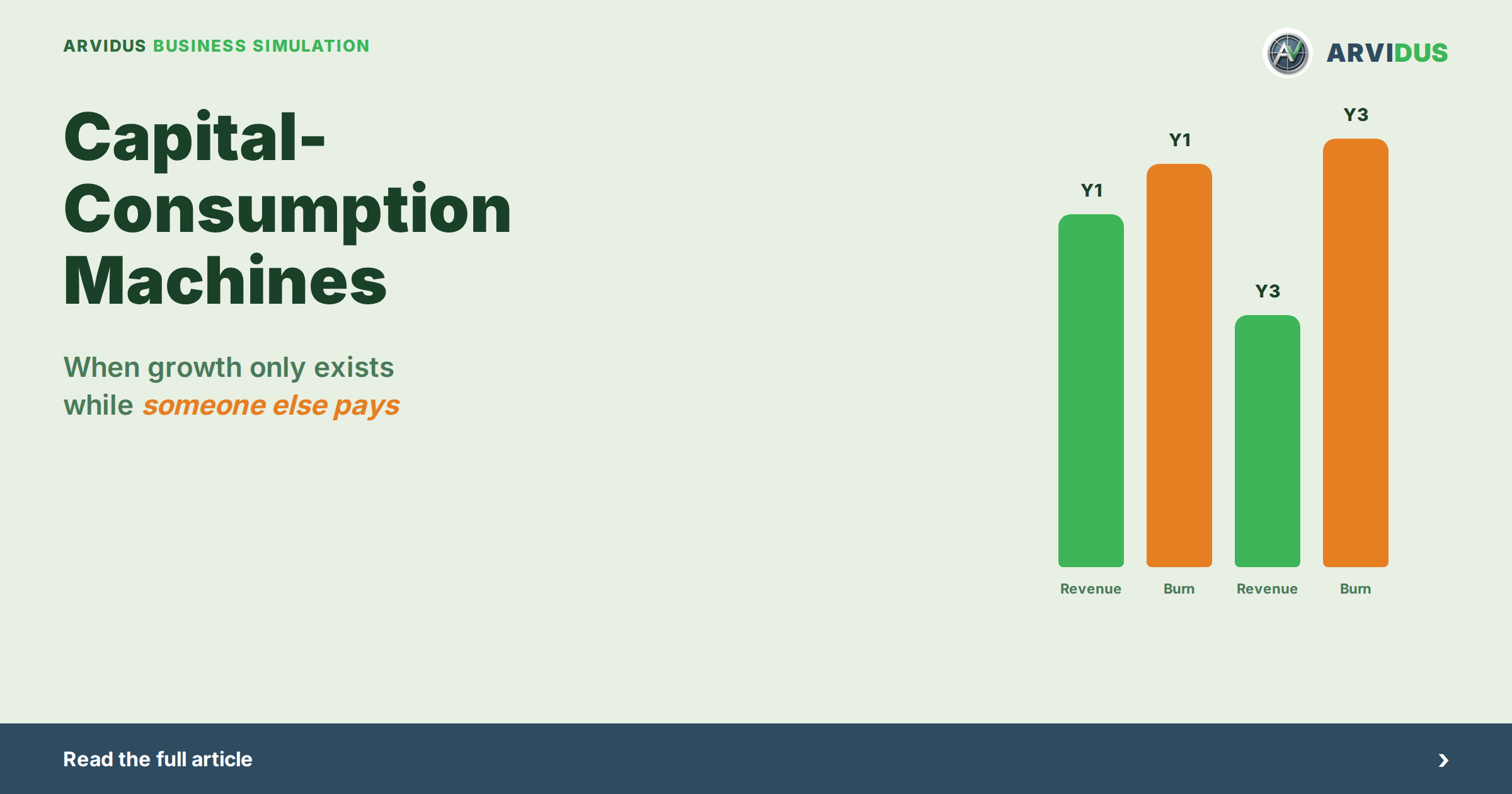
There is a question almost no one asks out loud. Not at innovation conferences, not at pitch days, not in the casual conversations founders have about building companies. The question is simple: if your external funding were cut off tomorrow, would your company survive?
Most wouldn't. And most founders know it, but won't say it. The vocabulary of the ecosystem has turned a narrow category of companies into the default template for success. Capital-consumption machines became synonymous with aspirational startup, and the question of sustainability became taboo.
"Closed a round" entered the language as a trophy. But raising money isn't revenue. It's debt, with interest that can cost a founder their company, and sometimes their sanity.
This article is about what happens when the bill arrives.
The number the ecosystem prefers to ignore
According to Shikhar Ghosh's research at Harvard Business School, which tracked more than 2,000 companies that received at least $1 million in venture capital between 2004 and 2010, 75% of those companies never returned money to investors. Not one dollar. Between 30% and 40% liquidated their assets at a total loss for everyone who bet on them.
We are not talking about modest returns. We are talking about total loss. Of every ten venture-funded startups, six shut down, three are acquired for modest sums, and only one generates a meaningful return. The top 10% produce between 60% and 80% of all returns in the sector.
That means the venture capital model was never designed for most companies to succeed. It was designed for a minority to succeed so spectacularly that they compensate for the other nine. The problem is that each of those nine had founders, employees, customers and communities who were affected by the failure.
The pattern is not uniquely American. In the UK, Beauhurst tracking data shows roughly 20% of high-growth UK companies fail within the first three years, and many more stall without ever reaching profitability. Across Europe, Atomico's State of European Tech consistently reports that the majority of venture-backed companies never return capital at the target multiple.
The anatomy of a capital-consumption machine
The pattern repeats itself. A company starts with a promising idea. It closes a seed round. It hires. It grows its user base through subsidy: discounts, free shipping, cashback, indefinite free tiers. The growth numbers look impressive. It raises a Series A. It repeats the cycle at larger scale.
What no one asks is: would those users pay the real price of the product?
In 2025, the fintech sector delivered a brutal answer. According to a TechBullion analysis, when customer-acquisition subsidies were pulled, the churn that had always been there became visible: 70% of users vanished within 60 days. They were not customers. They were beneficiaries of a model that only worked while someone was subsidizing it.
WeWork is perhaps the clearest case study. In January 2019, the company was valued at $47 billion. That same year, it lost $1.9 billion. The business was simple: rent shared office space. There was no revolutionary proprietary technology, no unassailable network effect. There was cheap capital, a charismatic founder, and investors who confused narrative with business model.
Adam Neumann, the founder, personally bought buildings and leased them back to WeWork. When the company tried to go public, the prospectus revealed what private investors had accepted without question: non-existent governance, structural conflicts of interest, and losses accelerating every quarter.
Theranos raised more than $700 million and reached a $9 billion valuation. The product, which promised to revolutionize blood testing, never worked. Did investors do due diligence? Some did. Most trusted the narrative.
Public money enters the same game
The problem is not exclusive to private capital. Governments around the world invest billions in startup incentive programs, accelerators, direct subsidies and tax exemptions. The intention is good: foster innovation, generate jobs, diversify the economy.
But the data shows clear limits. According to a study published in Research Policy, in Finland only 36% of subsidised startups survive after eight years. In France, 51%. In Germany, survival is higher (between 60% and 70% after 4.5 years), but even in the best cases, survival is not the same as sustainability. Surviving is not the same as turning a profit.
When startups are kept alive by public money, the question gains an ethical layer. That money comes from taxes. It comes from the public. If a company operated for years consuming public resources without generating sustainable employment, without returning value to the community, without building a business that can stand on its own, what exactly was financed?
The corner shop and the lesson we ignore
There is a deep irony in comparing the neighbourhood corner shop to the startup valued in the millions.
The shop owner has no pitch deck. No advisory board. No vanity metrics. But she knows, with surgical precision, what a case of tomatoes cost her, the margin on every product on the shelf, and how many customers she needs to serve per day to cover rent.
She validates the business every morning when she opens the door. If a product doesn't sell, she swaps it. If a price doesn't work, she adjusts. If the month doesn't close, she cuts costs. There is no "18-month runway." There is the reality of cash that has to clear every week.
The data confirms the intuition: according to the U.S. Bureau of Labor Statistics, traditional businesses have a survival rate of about 35% after 10 years. Startups? Around 10%. A company that grows slowly, validates in practice and reinvests its own profit is three times more likely to still exist a decade later.
This doesn't mean venture capital is wrong. It means venture capital without validation is an expensive bet. And most of the bets are being placed without anyone calculating the real probability of return.
70% of startups fail for the same reason, but nobody wants to hear it
CB Insights analyzed 431 startups that shut down since 2023 and updated a diagnosis the market has been repeating for a decade. The result:
- 43% failed from lack of product-market fit. They built something no one wanted to pay to use. It wasn't a lack of product. It was a lack of market.
- 70% cited "ran out of cash," but CB Insights now explicitly classifies that as the final symptom, not the root cause. The cash ran out because the model never sustained itself.
- 23% had the wrong team. Not a lack of talent. A lack of complementarity, operating experience or aligned incentives.
- 19% were outexecuted by competitors who simply did the work better.
The most revealing finding is the first: 43% built the wrong product. Nearly half. And the inevitable question: how many of those companies tested demand across more than one scenario before burning through millions?
The real market doesn't fit into a single scenario
Most founders make investment, hiring and go-to-market decisions based on a spreadsheet that tests one scenario: the optimistic one. CAC holds. Churn drops. The market grows as projected. And Excel accepts everything without complaint.
The deeper mistake goes beyond testing a single scenario. It is assuming the market is a uniform mass. That every potential user thinks alike, has the same purchasing power, values the same things, and reacts the same way when the economy shifts.
That market doesn't exist. It never did. The real market is a patchwork of segments with radically different behaviours, and each one reacts differently when the macro temperature changes.
When the economy shifts, the segments split
McKinsey's research on the "value-now consumer" shows a pattern that destroys any linear projection: when inflation and credit tighten, 80% of consumers trade down, but not all at the same time and not in the same categories. Lower-income households cut subscriptions first, pay only the essentials and renegotiate terms. Higher-income households keep splurging in a few pleasure categories and cut surgically in others. The same product, in the same week, loses 30% of one segment and 2% of another.
The same happens in B2B. A $60k/year enterprise contract survives a mild recession but gets frozen at the first corporate reorganization. An SME that signed a $49/month SaaS cancels the first time a card tightens. These are asymmetric cancellation behaviours, by cohort, by acquisition channel, by price sensitivity.
A subscriber who pays $9/month while employed cancels in the first tight month. A B2B customer who signed an annual contract renegotiates when the budget is cut. A user who came in through the free tier was never a customer, he was a vanity metric in the pitch deck. When the founder projected linear growth based on six months of tailwind, he discovers that the TAM on the slide was really just the fraction of the market with enough margin to keep paying full price when things get tight.
The segments the pitch deck hides
The real market is usually composed of at least four groups that the average founder treats as one:
- The early adopter who pays any price to experience novelty, and who represents at most 2% to 3% of the total market
- The price-sensitive customer who cancels on the first economic wobble, and who makes up the majority of the base
- The enterprise buyer who needs 6 to 18 months to approve a purchase and can freeze budgets at any moment
- The subsidised user who would never pay the real price, and who artificially inflates the growth metrics
When a founder says "1 million users," the question that should be asked is: how many pay the real price? How many would survive a 30% price increase? How many would cancel if they lost their job? How many are there only because the product is free? If the honest answer is "I don't know," the model wasn't tested. It was imagined.
From static spreadsheet to simulation of reality
The financial sector solved this problem 80 years ago. Banks, insurers and investment funds use scenario simulation as standard practice. They test thousands of possible futures before allocating capital. Not because they are more conservative, but because they understood that certainty is an illusion, and the only honest tool is a probability distribution.
A bank models what happens if unemployment rises three percentage points. An insurer calculates the impact of extreme weather events. An investment fund simulates its portfolio under recession, stagflation and accelerated-growth scenarios simultaneously, with segments reacting differently in each.
If a bank won't lend $100k without running a risk model that separates customer profiles, why does a founder invest $1 million on the basis of a spreadsheet that assumes a homogeneous market, constant churn and an unchanging economy?
The answer is simple: until now, accessible tools for doing this didn't exist. Multi-agent simulation was the preserve of trading desks and bank risk departments. The average founder didn't have the access, the time or the incentive.
That is changing. And it needs to change quickly, because the cost of not changing is already documented: 75% total loss, 43% built the wrong product, a majority of startups never reaching sustainable revenue.
Frequently asked questions about startups that consume capital without sustaining themselves
What is a capital-consumption machine?
A capital-consumption machine is a company whose business model only works while an external agent, a private investor, a government, or subsidised credit, pays the operating bills. If the capital stops, the company stops. Its own revenue doesn't cover operations in any realistic scenario, and growth depends on subsidised acquisition of users who never end up paying the real price.
What is the real failure rate of VC-backed startups?
According to Shikhar Ghosh's research at Harvard Business School, 75% of VC-backed startups never return money to investors, and between 30% and 40% liquidate at a total loss. If the definition of failure is "not delivering the projected return," Ghosh's own estimate runs as high as 95%.
Why do so many startups fail even with substantial funding?
According to CB Insights, 43% fail because of lack of product-market fit, they built the wrong product. "Ran out of cash" shows up in 70% of cases as a final symptom, not the root cause. Most of the time, capital was burned sustaining a thesis that was never tested against the real heterogeneity of the market.
Is opening a corner shop a better bet than starting a startup?
In terms of survival probability, yes. According to the U.S. Bureau of Labor Statistics, traditional businesses have around a 35% survival rate after 10 years, against around 10% for startups. That doesn't mean one path is better than the other. It means the grow-slow-and-validate approach is three times more likely to still be standing a decade later.
How can I validate a business model before burning capital?
By testing the thesis against different customer profiles, different macro scenarios and different cancellation behaviours, not against a single optimistic scenario. Scenario simulation, a standard technique in financial services for decades, lets you stress-test the model against thousands of combinations of CAC, churn, average ticket, price sensitivity and recession sensitivity before committing real capital.
The question that remains
Before raising the next round, before hiring the next engineer, before launching the next product, answer honestly:
If the investor asked for the money back tomorrow, where would it come from?
If the answer is nowhere, the problem isn't lack of capital. It's lack of a model.
And if your model only works in one scenario, it isn't a model. It's hope with professional formatting.
If your business decision is based on a spreadsheet with one scenario, the problem isn't your idea. It's your method.
Simulate free at arvidus.com