
Burn fast or compound deep: the silent war that decides who survives
Quibi burned $1.75B in six months. In-N-Out makes around $2B per year at 20% margin operating in eight states. The question isn't which is better. It's which one is yours.
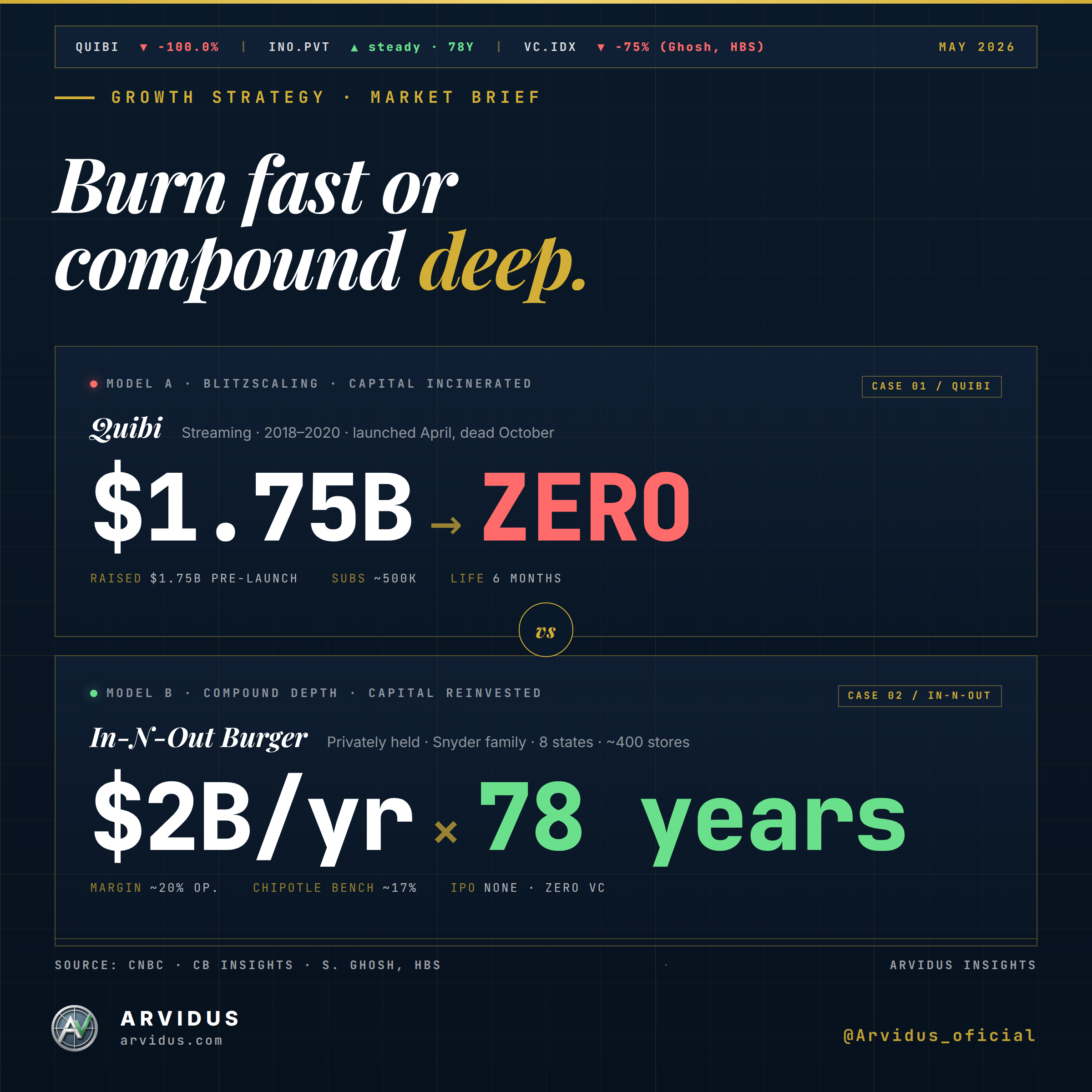
Quibi raised $1.75 billion before it even launched. Six months after launch, it shut down. It had around 500,000 paying subscribers, less than a third of its year-one target.
The same year Quibi imploded, In-N-Out, the Southern California burger chain, pulled in around $2 billion in revenue (per CNBC reporting), with operating margin estimated by industry analysts at roughly 20%. It operates in eight states. No venture capital, no IPO, no aggressive expansion. 78 years of growing slowly, in the same place.
Two growth philosophies, two opposite outcomes. And one question almost nobody in your boardroom is willing to ask out loud: what if accelerating is the worst advice you'll get this year?
Side A: the religion of "blitzscaling"
The dominant narrative of the last decade is simple. Raise capital, burn cash, capture market, set the standard, then think about profit. Reid Hoffman called it blitzscaling. The venture capital industry built trillions of dollars of thesis on top of the idea.
The problem is the numbers were never kind to it.
Shikhar Ghosh, senior lecturer at Harvard Business School, analyzed more than 2,000 companies that raised at least $1 million from VC. 75% never returned the capital to investors. Between 30% and 40% liquidated with investors losing everything. If you define failure as "didn't deliver the projected return," the number jumps to 95%.
CB Insights maintains the most well-known startup post-mortem in the market, now with more than 480 startups dissected. The real causes aren't "ran out of money." Running out of money is the symptom. The actual causes: no product-market fit (43%), wrong timing (29%), unsustainable unit economics (19%). Two-thirds of companies that die were already shrinking headcount in the six months before the collapse. Death is slow. Recognition arrives late.
And the iconic examples of the growth-at-all-costs era have become an expensive graveyard.
WeWork hit a $47 billion valuation in January 2019. It filed Chapter 11 in November 2023, with liabilities near $19 billion and assets of $15 billion. SoftBank booked an estimated $18.6 billion loss on the company, per its SEC filings. Adam Neumann walked away with more than $1 billion in personal net worth. The model, at its core, was arbitraging long lease contracts resold in short slices. Nobody needed $47 billion in venture capital to figure out that's not technology, it's real estate with free Wi-Fi.
Bird, the American shared electric scooter platform, became a unicorn in less than a year and reached a $2.5 billion valuation. In December 2023, it filed for bankruptcy with $1.6 billion in accumulated losses, sold for $145 million. The scooters didn't last long enough to pay back the fleet investment. The unit economics never closed.
Casper went public in February 2020 worth $575 million, about half what it was worth in its last private round ($1.1 billion). When it filed to go public, it was spending around $300 to acquire each mattress sold, on a product with a replacement cycle of nearly a decade. In November 2021, it announced a sale to a private equity fund for roughly a quarter of the IPO price. The entire D2C mattress category was leveled by copycats and acquisition costs in podcasts and subway ads.
The empirical rule of venture capital has always been: 1 in 10 works, that 1 pays for the other 9. But to be the "1 that pays," the company needs winner-take-all fundamentals. Network effects, defensible scale economics, real lock-in. Quibi didn't have it. WeWork didn't have it. Casper didn't have it. They were treated as if they did.
Side B: the silent economy that doesn't fit in TechCrunch
Meanwhile, the German Mittelstand keeps quietly manufacturing things most people don't even know are German. Small and mid-sized companies account for 53.1% of the country's workforce and 68% of exports in classic and high categories, according to the Institut für Mittelstandsforschung in Bonn. Hermann Simon catalogued more than 1,500 German "hidden champions" in his most recent research: global leaders hiding in specialty screws, packaging machines for pharma, optical sensors for semiconductors. Most operate for generations in a single region, with a single product, in a single global niche.
Average longevity tells the story. The Henokiens, a European association that only accepts family businesses with more than 200 years of continuous operation, has around 56 active members. None had VC, none scaled in the modern sense of the word. The Conway Center for Family Business measured average lifespan of family businesses in the US: 24 years. Average lifespan of non-family businesses: 8 years.
In-N-Out operates around 400 stores across a fraction of the United States, brings in about $2 billion in revenue, and has operating margin estimated near 20%, a high number for any chain in the sector. For context, Chipotle reported operating margin around 17% in 2024, and Shake Shack runs well above industry average in restaurant-level margin but with GAAP operating margin near zero. In-N-Out has never franchised, never gone public, remains private and controlled by the Snyder family. Each store does an average of $4.5 million per year in gross sales.
Trader Joe's sells around $1,750 to $2,100 per square foot of store space (roughly $19,000 to $23,000 per square meter). The American industry average is $370 to $465 per square foot. Walmart sits around $370, Whole Foods near $930. Private, part of the Aldi Nord group, it's operated for decades with limited assortment and no loyalty program.
Patagonia generates more than $1 billion in annual revenue, with approximate net profit of $100 million now flowing entirely to the Holdfast Collective, the environmental trust created by Yvon Chouinard when he donated the company in September 2022. Never went public, refused acquisition offers for decades.
These companies compete on a different axis. Not speed, depth. And depth compounded over decades beats nearly any benchmark of return per employee, per square foot, per dollar of capital deployed.
The concrete tradeoffs, in numbers
It's worth stopping and quantifying the trade, because "find the right balance" means nothing without figures.
Dilution. A company that does Series A, B, C, and D before IPO usually gives up between 60% and 80% of equity by the public offering. The typical unicorn founder ends up with 5-15% of the company they created. The owner of a solid regional company keeps 100%. Even if the regional business is worth 10x less on paper, the founder often ends up with more personal net worth.
Time to liquidity. The average IPO cycle for American SaaS companies, per public Pitchbook and Bessemer data, runs between 8 and 12 years. Regional family businesses generate continuous dividends starting in year 3-5. Whether you need cash flow now or can wait a decade is a different question than the one that shows up in pitch decks.
Operating margin. The median SaaS unicorn in Q1 2025 had 10% growth, 6% EBITDA margin, and a Rule of 40 score of 12, per Abacum and SaaS Capital. Below the historical benchmark of 40. The typical German Mittelstand operates with 8-12% EBIT and grows 3-5% per year by volume, but does it for 50, 80, 200 consecutive years. Reinvested capital compounds.
Customer acquisition cost. D2C VC-backed companies of the 2015-2020 vintage spent more on acquisition than on product. Casper lost $300 per mattress. In-N-Out and Trader Joe's spend virtually zero on paid marketing. They grow through word of mouth, local frequency, and density of loyal customers per zip code.
When fast scaling makes sense
Ignore the fad, look at the structure. Scaling fast is rational in three configurations.
Strong network effects. When the value to each user grows with each new user, getting there first and dominating the curve is everything. Two-sided marketplaces, social networks, communication standards. Here, second place dies. Slack, Uber, Airbnb. It makes sense to burn cash to win.
Radical scale economics. When unit cost drops dramatically with volume, and volume only comes with massive upfront investment. Semiconductors, batteries, automotive manufacturing. AWS is the canonical example: invested for a decade before being profitable, today operates with margins no competitor can replicate.
Regulatory window. When there's a short window before regulation arrives, or when first-mover captures a scarce license. Telecom, fintech in emerging markets, certain digital health verticals.
Outside these three, "scale first, profit later" is a bet without a foundation. And most of the startups that raised $100, $200, $500 million over the last ten years aren't in any of the three.
When local/regional makes sense
The direct inverse. Structurally high margins in a niche. Personalization and relationships that don't scale through technology. Local regulation that creates barriers to outside entry. Service models where local reputation is the main asset.
Premium restaurants, regional law firms, specialty distributors, B2B industrial component manufacturers, accounting, boutique consulting, wineries, cheesemakers, artisanal brands with geographic identity. In all these categories, scaling aggressively destroys what makes the business valuable. Marginal revenue from each new customer drops faster than the marginal cost of serving them, identity dilution kills the premium, the founder loses the only thing that mattered: direct contact with the operation.
In-N-Out tested expansion to the eastern US and stopped. Trader Joe's expanded slowly and still operates with just over 600 stores after decades. It's not incompetence, it's the strategic choice of someone who understood their utility function.
The middle trap: neither fish nor fowl
The most dangerous category isn't the one that scales fast well or operates locally well. It's the one that tries to scale fast without winner-take-all fundamentals.
Casper, Brandless, Outdoor Voices: all had regional-margin economics, all were treated like global platforms, all imploded or were sold under bad conditions. Casper wanted to be a mattress unicorn without network effects, without defensible scale economics. Brandless received a commitment of up to $240 million from SoftBank Vision Fund and shut down with about half of that effectively deployed, no brand, no proprietary distribution, no cost advantage. Outdoor Voices wanted to be Lululemon in fast-forward, without the two decades of brand capital Lululemon built, and was sold in 2024 to a private equity fund under conditions very different from the original promise.
Raising capital in this scenario accelerates the mistake, doesn't fix it. Every million raised is one more million to burn before the recognition that the model was never going to scale.
The 2023-2025 pivot: the market is relearning
The industry has already started to correct. SaaS companies in the $1-3 million ARR range improved median margin from -53% to -8% in two years, per SaaS Capital. Not because they chose to, because they were forced. The market closed for cash burn, and whoever didn't have an efficiency plan died first.
Bessemer and a16z started publishing theses defending "growth-at-reasonable-cost" and "default alive." Y Combinator hardened the profitability-first message in recent batches. M&A started preferring companies with Rule of 40 above 40 and EBITDA breakeven, instead of companies growing 80% with -40% margin.
That doesn't mean blitzscaling is over. It means the pendulum is swinging back to the point where business structure decides growth strategy, not the fad of the moment.
And your small business in a small town? Can it scale? Is it ready?
Most of this article talks about multimillion-dollar companies and billion-dollar funds. But the majority of entrepreneurs reading this don't have a Series A, don't have access to Sand Hill Road, and probably operate somewhere the phrase "venture capital" has never been said in a chamber of commerce meeting.
The good news is the framework is the same.
If you run a bakery, a carpentry shop, a clinic, a small e-commerce store, or a service firm in a small town, you're already playing the local depth game. The main asset isn't technology, it's reputation. The competitive advantage isn't capital, it's loyal customer frequency. The same rules that keep Trader Joe's and In-N-Out profitable work for you, at proportional scale.
That doesn't mean staying where you are. It means building the right operation for the kind of growth that makes sense.
Growing locally means going from one store to three in the same town, dominating a niche, becoming the reference within a radius. Each new unit or loyal customer adds margin, doesn't dilute it. Growing "globally" for most small businesses means selling online to other states or countries without needing to open physical stores abroad. It's viable, it's cheap, and it doesn't require venture capital.
And for those thinking about starting: the most expensive mistake today isn't starting too small, it's copying the unicorn playbook. Don't take a loan to burn cash on marketing before you've validated that each new customer pays back acquisition cost in less than a year. Don't build the administrative structure of a $10M company before you're doing $1M in revenue. Don't confuse growing fast with growing.
The preparation that opens doors to private funds in the future is the same preparation that keeps the business alive today: organized financial data, real margin known, customer cycle measured, replicable process documented. No fund, domestic or foreign, will look at you if your spreadsheet lies. They'll look when the numbers speak for themselves.
Geography still determines a lot of what looks possible. But what defines who gets there isn't the town where you were born, it's structural clarity about the game you're playing.
What this means for whoever's about to bet capital
There's no universal answer, there's an answer for your case. And your case depends on variables that very few founders sit down to map before signing the term sheet.
What's your business worth across five distinct scenarios of growth speed? What changes in your final equity between growing 30% per year for 10 years at 15% margin versus growing 100% for 4 years at -30% margin? In how many scenarios is your current decision to raise a Series A still the best decision? In how many is it the worst?
The difference between Quibi and In-N-Out wasn't founder intelligence. It was structural clarity about what kind of game each one was playing. Quibi thought it was in a network-effect platform game. It was in a content game, where Netflix and Disney had already won. In-N-Out knows exactly what game it's in, and has refused every invitation to change.
The question that should be at the top of the five-year plan isn't "how fast will we grow." It's "in how many scenarios does our decision survive." Whoever answers the first chooses dogma. Whoever answers the second keeps control.